Multilingual Hotel Menu: How to Translate It Well
Why a multilingual hotel menu brings more orders and fewer questions, and how to translate it: machine draft, human review, dish names, what to keep as is.
By the Roomtray team 6 min read
A multilingual hotel menu is one of the cheapest improvements a small hotel can make. A guest from Vienna, Kraków or Kyiv who opens the in-room menu in their own language orders faster, asks fewer questions and makes fewer mistakes. This guide explains why the guest's language matters for room service and how to translate a hotel menu properly, with a workflow you can finish in one afternoon.
Why the guest's language matters for room service
A room service order happens without a waiter. Nobody stands next to the guest to explain what "Svíčková na smetaně" is, whether "Kaiserschmarrn" is a dessert or if the soup contains meat. When a guest cannot understand a line, they usually do one of two things: skip it or call reception.
Both cost you. A skipped dish is lost revenue. A call takes your receptionist away from the guest who is checking in. And a guessed order often comes back as a complaint: "I thought it was a salad."
There is also a trust factor. A guest who sees a careful menu in their language assumes the kitchen is careful too. A menu with broken English or a single language for an international audience sends the opposite signal.
Which languages to offer first
Don't start with ten languages. Start with the guests you actually have. Open your booking data for the last 12 months and list the top countries of origin.
A typical picture for a small hotel in Central Europe:
| Hotel location | Sensible first set |
|---|---|
| Prague, Brno | Czech, English, German, Ukrainian |
| Vienna, Salzburg | German, English, Italian |
| Kraków, Wrocław | Polish, English, German, Ukrainian |
| Bratislava, High Tatras | Slovak, English, Czech, Polish |
English is always in the set because it is the fallback for everyone else. Add a language when a nationality appears regularly in your bookings, not because it looks impressive.
A workflow: machine draft, then human review
Machine translation is good enough for a first draft today. It is not good enough to publish without a check. Food vocabulary is full of regional words, and a machine does not know what your kitchen actually puts on the plate.
A workflow that works for a menu of 30 to 60 items:
- Write the source menu carefully. Short, clear sentences in your main language. Ingredients named precisely: "pork neck", not "meat". A messy source gives a messy translation in every language.
- Create a machine draft for all languages at once.
- Ask a native speaker to review each language. A member of staff, a regular guest, a friend. Give them the source text next to the translation so they can compare.
- Check the critical words separately: allergens, meat type, spiciness, "vegetarian", "vegan", "gluten-free". These lines must be exact.
- Read the menu on a phone in each language. Long German compounds and Ukrainian endings may break layouts that looked fine in English.
Review takes 30 to 60 minutes per language for a typical room service menu. Do it once properly and then only review changes.
What not to translate
Some things should stay as they are in every language:
- Brand names and signature dishes. "Aperol Spritz", "Coca-Cola", the name of your house burger.
- Local specialities that guests may want to try exactly because they are local: Svíčková, Wiener Schnitzel, Pierogi, Borshch. Keep the original name and add a short explanation.
- Prices, currency and portion sizes. Use the same numbers everywhere. Only the format of decimals may change.
- Wine names and appellations. "Grüner Veltliner" stays "Grüner Veltliner".
What you must always translate: ingredients, cooking method, allergens, side dishes, and any condition like "available until 22:00" or "serves 2".
How to handle dish names
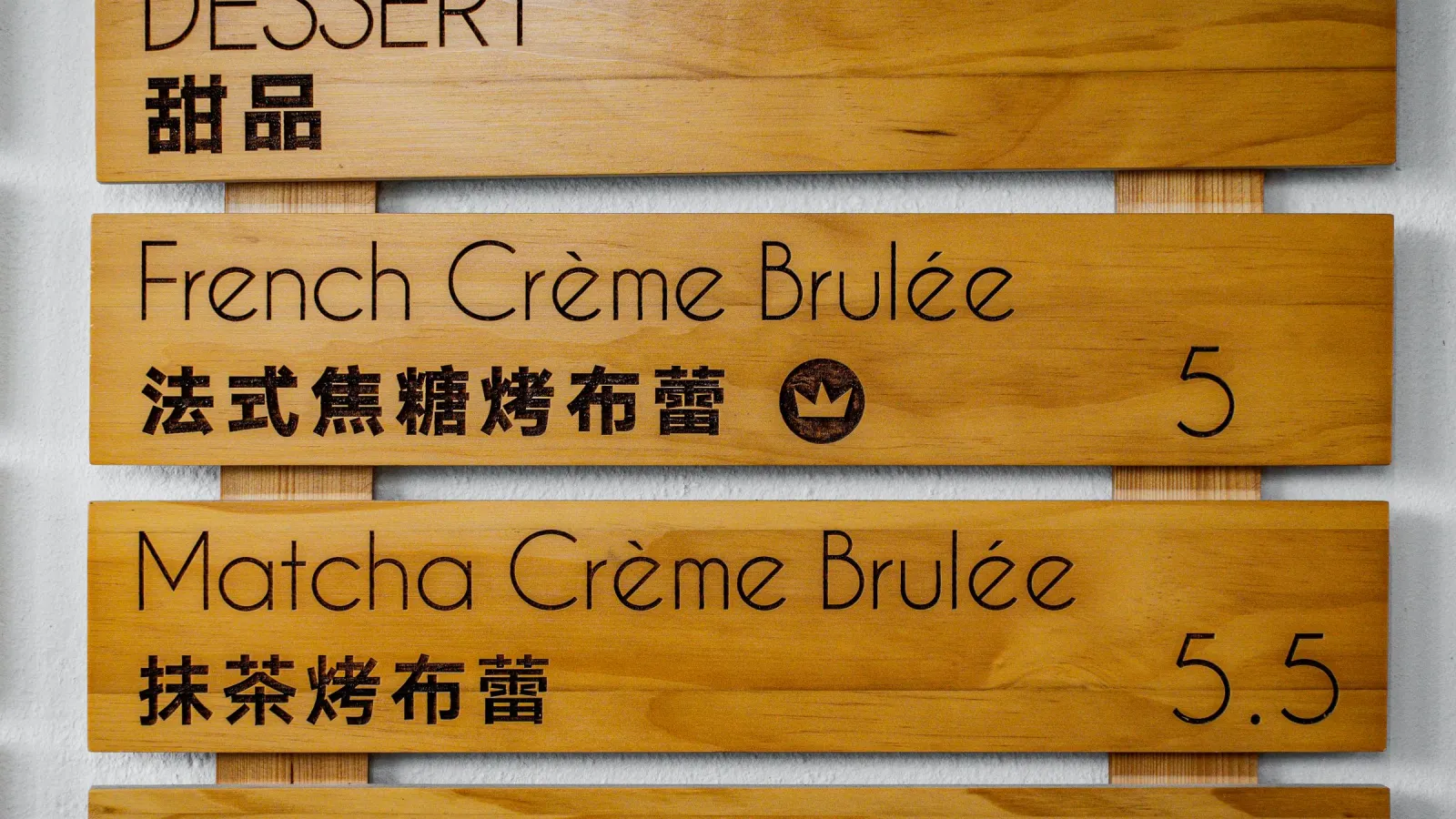
The most useful pattern for a hotel menu is "original name + plain description".
Good:
Svíčková na smetaně - beef sirloin in creamy vegetable sauce, bread dumplings, cranberries
Bad:
Sirloin on cream (literal translation that means nothing)
Also bad:
Svíčková na smetaně (no description, the guest has no idea what it is)
For simple dishes there is no original name to keep. "Club sandwich", "Caesar salad" or "omelette with cheese and ham" are simply translated.
The description does the selling. If you want help with that part, read our guide on menu descriptions that sell.
Example: one menu line in four languages
| Language | Menu line |
|---|---|
| Czech (source) | Svíčková na smetaně - hovězí svíčková, smetanová omáčka, houskový knedlík, brusinky |
| English | Svíčková na smetaně - beef sirloin in creamy vegetable sauce, bread dumplings, cranberries |
| German | Svíčková na smetaně - Rinderlende in Rahmsauce mit Wurzelgemüse, Semmelknödel, Preiselbeeren |
| Ukrainian | Свічкова на сметані - яловича вирізка у вершковому соусі з овочами, хлібні кнедлики, журавлина |
Note that the German line says "Rahmsauce" and "Semmelknödel", words an Austrian or Bavarian guest knows from home. A machine might produce "Sahnesoße" and "Brotknödel", which are understandable but less natural. This is exactly the kind of detail a human reviewer fixes.
Common mistakes
- Translating once and forgetting. You change a side dish in Czech, and the English version still promises fries. Every menu change needs all languages updated.
- Mixing languages on one screen. Category names in English, dishes in German, buttons in Czech. Guests lose orientation.
- Literal idioms. "Grandma's recipe" may sound odd in some languages. Keep it simple.
- Unclear units. "0.33" means nothing without "l". "200 g" should be next to the meat, not hidden.
- Allergens only in the main language. This is the most dangerous mistake. The 14 EU allergens must be clear to every guest, in every language. We explain the rules in our article on the 14 EU allergens.
Keeping translations up to date
A printed menu in four languages means four sets of PDFs to redo each time the kitchen changes something. That is why many hotels keep outdated paper menus for years.
A digital menu solves this when every item stores all its languages in one place. You change the price once, it changes everywhere. You add a new dish, and the system shows which languages are still missing.
In Roomtray, every dish, category and information page has fields for each language, and the guest sees the menu in the language of their phone, with the hotel's main language as a fallback. You can see how it works in the multilingual menu overview. Machine drafts are available, but the review step stays with you, because only your team knows what the kitchen serves.