The 14 EU Allergens on a Hotel Menu: What to Show
The 14 EU allergens under Regulation 1169/2011: what a hotel must tell guests about food, how to show allergens on a digital menu and how to train staff.
By the Roomtray team 7 min read

The 14 EU allergens are not optional information on a hotel menu. Since December 2014, every business that serves food in the EU, including a small hotel with a room service menu or a breakfast buffet, must be able to tell guests which of the 14 major allergens are in each dish. This article explains what the rules say, how to show allergens on a digital menu and how to prepare your team so a guest's question never ends with "I'm not sure".
This is a practical guide, not legal advice. National details differ, so check with your local food authority when in doubt.
What the law requires
The core rules come from Regulation (EU) No 1169/2011 on the provision of food information to consumers:
- Article 9(1)(c) makes the presence of allergens mandatory food information.
- Annex II lists the 14 substances or products that cause allergies or intolerances.
- Article 44 extends the duty to non-prepacked food, which is everything a hotel kitchen cooks and serves. Member states may decide how the information is provided (written, oral, by symbols), but they cannot remove the duty itself.
For a hotel this covers room service, breakfast, the bar menu, snacks at reception and packed lunches. If you serve it, you must be able to say what allergens it contains.
The 14 allergens and where they hide
| # | Allergen (Annex II) | Typical places in a hotel kitchen |
|---|---|---|
| 1 | Cereals containing gluten: wheat (incl. spelt, khorasan), rye, barley, oats | bread, breadcrumbs, pasta, flour in sauces, beer |
| 2 | Crustaceans | prawns, shrimp paste, some Asian sauces |
| 3 | Eggs | mayonnaise, pastry glaze, pancakes, breaded schnitzel |
| 4 | Fish | Caesar dressing (anchovies), Worcestershire sauce |
| 5 | Peanuts | satay, granola, some baked goods |
| 6 | Soybeans | soy sauce, soy lecithin in chocolate, vegan products |
| 7 | Milk (incl. lactose) | butter, cream sauces, cheese, many breads |
| 8 | Nuts: almonds, hazelnuts, walnuts, cashews, pecans, Brazil nuts, pistachios, macadamia | pesto, cakes, muesli, nut spreads |
| 9 | Celery | stock, soups, spice mixes, Bloody Mary salt |
| 10 | Mustard | dressings, mayonnaise, marinades, sausages |
| 11 | Sesame | burger buns, hummus (tahini), Asian dishes |
| 12 | Sulphur dioxide and sulphites above 10 mg/kg or 10 mg/l (as SO2) | wine, dried fruit, some vinegars |
| 13 | Lupin | lupin flour in some breads and pastries |
| 14 | Molluscs | mussels, squid, oyster sauce |
The tricky items are rarely the obvious ones. Everyone knows a prawn cocktail contains crustaceans. Fewer people remember the celery in the stock cube used for the soup of the day, or the soy lecithin in the chocolate on the breakfast buffet.
Local practice in Central Europe
The regulation is the same across the EU, but the presentation differs:
- Czechia: menus commonly use numbers 1 to 14 in the Annex II order, with a legend at the bottom.
- Austria: the Allergeninformationsverordnung sets national rules, and letter codes A to R are widely used (for example A for gluten, G for milk).
- Germany: the LMIDV allows oral information if written documentation is available on request and the guest is told about it.
If your guests are international, numbers or letters alone are not enough. A guest from Spain does not know that "7" means milk. Always pair codes with words in the guest's language.
How to show allergens on a digital menu
A digital menu makes allergen information easier to keep correct, because you enter it once per dish and every language shows it.
What works well:
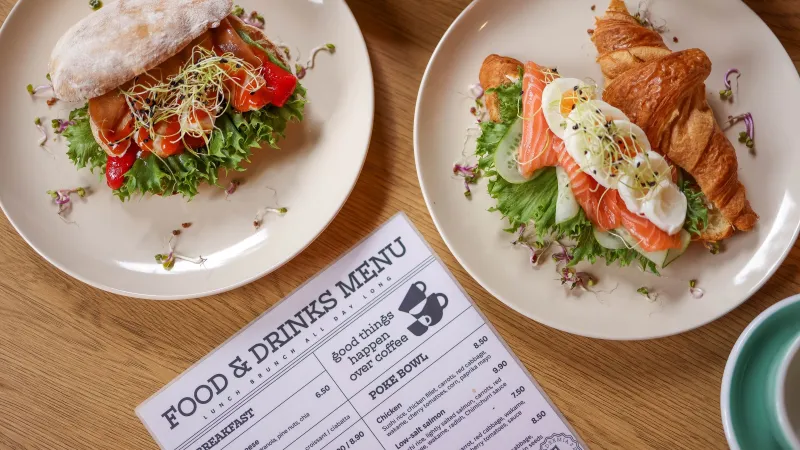
- Allergens on the dish card, not hidden behind a separate PDF. The guest sees "Contains: milk, eggs, gluten" next to the price.
- Icons plus text. Icons are fast to scan, but the word must be there too.
- Filters. "Hide dishes with nuts" saves the guest from reading 40 lines.
- Translated labels. The allergen names must appear in every menu language, not only in yours. We cover translation in our guide to a multilingual hotel menu.
- A clear note at the top or bottom: "Ask our staff if you have a severe allergy. We prepare all dishes in one kitchen."
Example dish line:
Caesar salad with chicken - romaine, grilled chicken, parmesan, croutons, anchovy dressing. €14 Contains: gluten, eggs, fish, milk, mustard
Behind the menu: recipe sheets and supplier labels
The menu is only as accurate as the information behind it. For each dish, keep a simple recipe sheet:
- every ingredient, including sauces, stocks and garnishes
- the brand of each bought-in product
- the allergens from that product's label
- the date of the last check
When a supplier changes a product, the allergens may change too. Make "check the label" part of receiving goods. If the cook swaps one brand of bread for another, the menu must follow.
Training your staff
Everyone who takes an order or carries a tray must know what to do. A short checklist for training:
- Where allergen information for each dish is stored, and who keeps it current.
- Never guess. "I'll check with the kitchen" is always the right answer.
- How to mark an allergy on an order so the cook sees it before cooking.
- Basic cross-contact rules: clean board and knife, separate fryer oil, no garnishing by hand from a shared bowl.
- What to do if a guest has a reaction: call emergency services (112 in the EU), inform the manager, keep the packaging and recipe sheet.
Repeat the training when you hire someone new and every time the menu changes significantly. A ten-minute briefing at the start of the season costs little.
"May contain" and honest limits
A small hotel kitchen usually cannot guarantee that a dish is free from traces. Be honest about it. If you use flour in the same room, write a general note instead of promising "allergen-free". Note also that "gluten-free" is a regulated claim in the EU (Regulation (EU) No 828/2014, max 20 mg/kg), so use it only when you can stand behind it.
How Roomtray handles allergens
In Roomtray, you tick the allergens for each dish once, and the guest sees them translated in their own language, with filters to hide what they cannot eat. Details are on the allergens feature page. The data is only as good as your recipe sheets, so the routine above stays your job.